
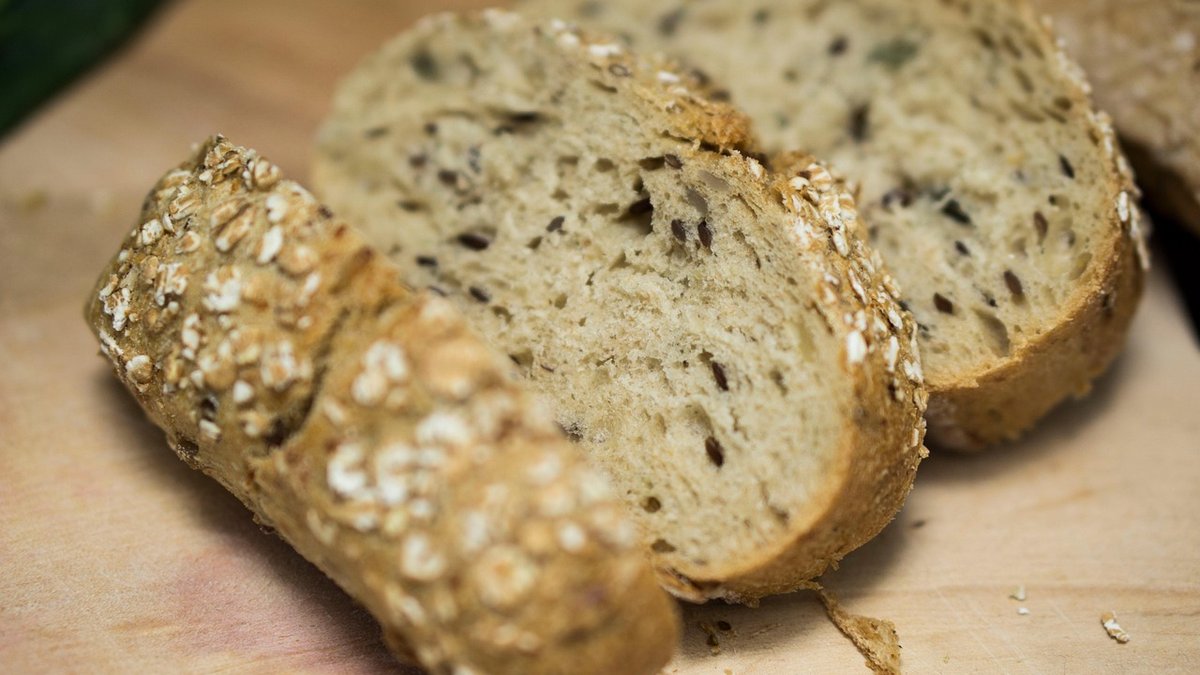
Wholemeal flour is wonderful stuff, but it does not behave like white. The bran particles in the flour are sharp little flakes that slice through gluten strands as the dough proves, and they soak up water like blotting paper. The result, all too often, is a loaf that rises sluggishly and bakes into something worthy but dense — perfectly pleasant toasted, less so when you want a tidy cheese and pickle sandwich that holds together.
The fix is not to abandon wholemeal altogether. It is to give it support. A proportion of strong white flour lightens the load, milk and a little fat tenderise the crumb, and a slightly wetter dough than you might expect keeps everything soft for days. Get those three things right and you can have a loaf that is at least half wholemeal and still slices thinly without crumbling.
My house standard is a 4:1 ratio — 400g of wholemeal bread flour to 100g of strong white. That gives you a genuinely wholesome flavour and a decent dose of fibre, while the white flour supplies enough extensible gluten to carry the rise. Push it to 50:50 and you get a lovely everyday loaf, softer still but milder in taste. Push much beyond 80 per cent wholemeal and you are back in doorstop territory unless you add extras such as a soaker or a tangzhong-style paste.
For one 900g (2lb) loaf tin you will need:
Wholemeal flour absorbs more liquid than white, so do not be alarmed if the dough feels sticky at first. Hold back 20ml of the water and add it only if the dough seems tight after a minute of mixing.
The single biggest upgrade to a wholemeal sandwich loaf is swapping some of the water for milk. Milk contains proteins and lactose that gently enrich the dough, and the fat in whole milk shortens gluten strands just enough to produce a finer, softer crumb. Scalding the milk first and letting it cool to lukewarm is an old baker's trick: it denatures a protein that can otherwise slacken the gluten, and it makes the crumb noticeably more velvety. If you are short of time, gently warming the milk to about 38°C — just above blood heat, no hotter or you will knock the yeast back — is perfectly adequate.
The butter or oil matters too. Two tablespoons sounds trivial in a 500g flour dough, but it is the difference between a slice that folds around a filling and one that snaps. Add it after the dough has come together, not with the initial mix, so the gluten has a chance to develop first.
Combine the flours, yeast and salt in a large bowl, keeping the salt and yeast apart until they are distributed. Pour in the warm milk mixture and the honey, stir with a wooden spoon to a shaggy mass, then tip onto a lightly oiled worktop. Knead for ten minutes by hand, or six in a stand mixer on low, adding the butter in two additions once the dough is smooth. You are looking for a dough that is soft, slightly tacky and passes the windowpane test in a rough sort of way — wholemeal will never be truly translucent.
Cover and leave to rise somewhere draught-free at around 22–24°C for one and a half to two hours, until roughly doubled. Wholemeal doughs rise more slowly than white, so judge by appearance rather than the clock. If your kitchen is cold, a switched-off oven with just the light on works well.
Turn the dough out, press it flat to knock out the big bubbles, then roll it into a tight cylinder and drop it seam-side down into a buttered 900g loaf tin. Cover loosely with oiled cling film or a shower cap and prove for 45 to 60 minutes, until the dough crests just above the rim and springs back slowly when pressed with a fingertip.
Bake at 200°C (180°C fan, gas mark 6) for 35 to 40 minutes. If the top browns too quickly, tent it with foil after 25 minutes. The loaf is done when it sounds hollow tapped on the base and reads 96°C on a probe thermometer. Turn it out of the tin straight away and cool on a wire rack — resisting the urge to cut it warm, which lets steam escape and stodges the crumb.
Once completely cold, store the loaf in a cotton bag or a bread bin rather than the fridge, which speeds staling. For slices beyond day three, freeze the loaf half-cut and toast from frozen. A spoonful of milk powder added with the dry ingredients, or a 30g portion of cooked mashed potato worked into the dough, will both stretch freshness by another day. And if you fancy a variation, swap 50g of the wholemeal for rye or spelt, or scatter a handful of sunflower seeds through the final shaping — the soft crumb will carry them beautifully.

Hi, my name is Anthony kuber. I am artist and fashion designer.
I love to travel and writing blogging.
Your email address will not be published. Required fields are marked *
Software Developer & Writer
Hey, I'm Diva, a developer and writer blending code and creativity. I'm driven by a deep curiosity and a relentless pursuit of excellence. Join me as I craft digital solutions and captivating stories.


